Outcomes Framework - Success Criteria
Success Criteria are used in Effectiveness Metrics to determine whether a particular Treatment Episode should be considered "Successful". You may set as many criteria as you like, but only one needs to occur for the Treatment Episode to be considered a success.
These Success Criteria apply only for Effectiveness Metrics.
ONLY ONE Success Criteria must be met for a patient to be considered Successful.
Changing Success Criteria
When creating or editing a metric, a Success Criterion is recommended and defaulted in the templates. These can be adjusted or deselected using the checkbox.
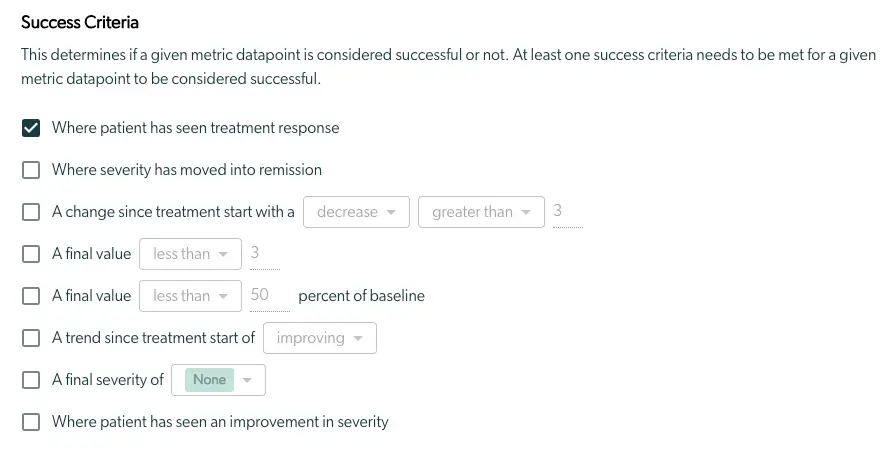
By default, the template selects only when there is Treatment Episode Response.
Whenever you change something, the "Statistics" will change immediately.
Success Defined
Each of the Success Criteria are described in more detail below.
Treatment Episode Response
When selected, a Treatment Episode will be considered a success if the difference between the baseline measurement and the selected measurement in the Time Period is considered to have shown Treatment Episode Response, as defined in detail here.
Mirah recommends as a default using this as a Success Criteria.
Treatment Episode Remission
When selected, an Treatment Episode will be considered a success if the selected measurement in the Time Period is considered to be in remission, as defined here.
Note that you may wish to consider supplying an Inclusion Criterion to remove any patients who were already in remission at the Treatment Episode start if you intend to measure how many patients moved into remission rather than started in remission for that particular scale.
Mirah recommends as a default using this as a Success Criteria.
Change Since Treatment Episode Start
This criterion is only available for Numerical Scales which can express a raw score.
When selected, a Treatment Episode will be considered a success if the raw score of the selected scale in the selected measurement meets the criteria given. For example:
- A change since Treatment Episode start with a decrease greater than 3 on the PHQ-9
- A change since Treatment Episode start with a increase greater than 3 on the GAD-7
Final Value
This criterion is only available for Numerical Scales which can express a raw score.
When selected, an Treatment Episode will be considered a success if the raw score of the selected scale in the selected measurement meets the criteria given. For example:
- A value of < 4 on the PHQ-9
- A value equal to 9 on the GAD-7
- A value > 5 on the Child Hope Scale (a strength based scale measuring hope in adolescents)
Use "Final Value" if you have a specific definition from an external party, or the scale you are measuring does not support a remission metric.
Final Value as a % of Baseline
This criterion is only available for Numerical Scales which can express a raw score.
When selected, a Treatment Episode will be considered a success if the % difference between the baseline score of the selected scale and the final score meets the criterion given. For example:
- The final score is < 50% of the baseline
- The final score is > 20% of the baseline
This metric is often used as a proxy for Treatment Episode Response.
Use final value percentage if you have a specific definition from an external party, or the scale you are measuring does not support a Treatment Episode Response metric.
Trend in Treatment Episode
This criterion is only available for scales which support "Trend" in Treatment Episode, as defined here.
When selected, a Treatment Episode will be considered a success if at the evaluation point, the measure reports the given trend. Most commonly, you will select "Improving" as the appropriate trend. In most cases, it will be easier to use "Treatment Episode Response" as a criterion instead.
Use trend in Treatment Episode when you want to ask specifically about trend, rather than about Treatment Episode Response more generally, or if you are looking to answer questions such as ‘how many patients stabilized?’.
Final Severity
This criterion is only available for scales which support Clinical Severity Categories.
When selected, a Treatment Episode will be considered a success if at the evaluation point, the severity of the measure is in the given set of categories. For example:
- The final severity is ‘None’. (This is also the definition of Treatment Episode Remission)
- The final severity is ‘None’, or ‘Mild’.
- The final severity is ‘None’, ‘Mild’, or ‘Moderate’.
Use "Final Severity" if you have specific clinical severities you are targeting as a criterion for success, particularly if "mild" is considered a success. Use "Remission" instead if you consider only "None" as a success.
Improvement in Severity
This criterion is only available for scales which support Clinical Severity Categories.
When selected, a Treatment Episode will be considered a success if at the evaluation point, the severity of the measure is better than upon intake. For example:
- The final severity is ‘None’, or ‘Mild’, and the initial severity was ‘Severe’
- The final severity is ‘None’, and the initial severity was ‘Mild’
This is useful when you are looking to prove some level of Treatment Episode success that does not go as far as remission, particularly for scales where treatment episode response is not very well defined.